

Get an Instant Towing Service Quote: A How-To Guide
Table of Contents
What You Need Before You Request a Towing Service Quote
Information to Have Ready for Dispatch
Step 1: Confirm Your Exact Location and Vehicle Details
Step 2: How to Check if Your Insurance Covers Towing
Where to Find Towing Coverage in Your Policy
Step 3: Understand Towing Service Price Factors Before You Call
Hook-Up Fees vs. Mileage Rates
Step 4: Ask the Right Questions to Lock In Your Quote
Step 5: Know the Average Towing Cost in South Milwaukee
Common Mistakes to Avoid When Getting a Towing Quote
Frequently Asked Questions
Last Updated: October 2, 2026
What You Need Before You Request a Towing Service Quote
Knowing what to have ready before you call is the difference between a two-minute quote and a twenty-minute runaround. A towing service quote moves fastest when you can answer four things without searching: where you are, what you drive, where it needs to go, and how it will pay. This guide from Boost Towing & Recovery LLC walks through the questions that stop surprise charges before they happen.
Most drivers call with one detail missing, and that missing detail is usually the one that changes the price.
Here's the part most guides skip: the quote itself is not the hard part. Getting an accurate one is. A dispatcher who knows your exact location, vehicle type, and destination can commit to a number. A dispatcher guessing at any of those has to pad the estimate, and you pay for the padding.
Below, we break down what to have ready, how to check your insurance, which price factors actually move the number, and the five questions that lock a quote in place.
Key Takeaway The fastest way to get an accurate quote is to call with your location, vehicle, destination, and payment method ready. Missing any one of these turns a firm quote into a rough guess.
Information to Have Ready for Dispatch
Dispatchers price on four inputs. Have all four within reach before you dial:
Exact location: street address, nearest cross street, or mile marker. On I-94, the mile marker matters more than the exit name.
Vehicle details: make, model, year, and whether it rolls, steers, or is locked in park.
Destination: the shop, dealership, or address it needs to reach.
Payment method: card, cash, or insurance claim. This determines what the dispatcher can confirm on the call.
One more item, and it's the one people forget: your phone's location services. If you can share a live pin, you remove the single biggest source of quote error.
Step 1: Confirm Your Exact Location and Vehicle Details
Precision here is worth real money. A quote built on "somewhere near the airport" will always come back higher than one built on a pin dropped at a specific mile marker, because the dispatcher has to protect against being wrong.

Give the dispatcher these specifics:
The road you're on and the direction you're traveling
The nearest exit, cross street, or mile marker
Whether you're on the shoulder, in a lot, or in a garage
Whether the vehicle is accessible to a truck, or blocked by traffic or a low clearance
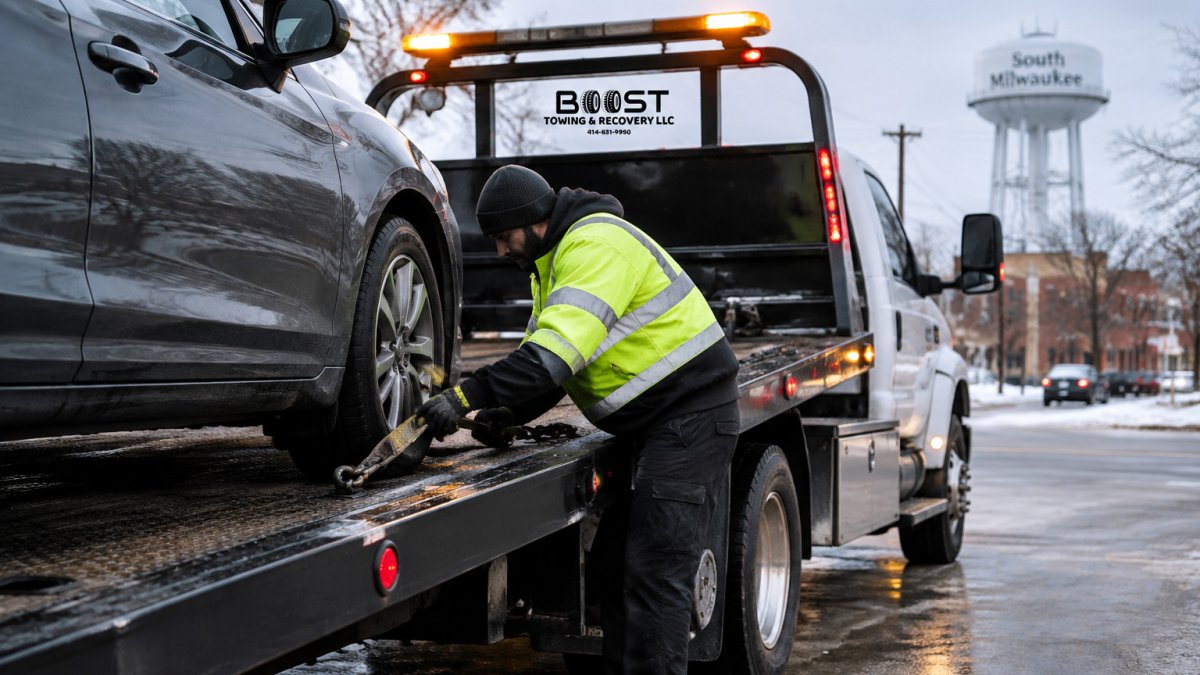
Vehicle details change the equipment required, and equipment changes the price. A standard sedan on a wheel lift is a different job than a full-size pickup that needs a flatbed. An exotic or low-clearance car needs a flatbed and a driver who knows how to load it without scraping the front lip.
Pro Tip If you're on an interstate, read the mile marker off the nearest green sign. It's faster and more accurate than trying to describe landmarks, and it lets the dispatcher route the closest truck immediately.
Step 2: How to Check if Your Insurance Covers Towing
How to check if your insurance covers towing: open your policy's declarations page, find the coverage section, and look for "towing and labor," "roadside assistance," or "emergency road service." If it's listed, note the per-incident limit and whether it reimburses you or pays the provider directly. If it isn't listed, you're paying out of pocket unless you have a separate membership.
Where to Find Towing Coverage in Your Policy
Coverage hides in different places depending on your insurer. Check these three spots in order:
The declarations page at the front of the policy. This summarizes what you bought.
The endorsements or riders section. Towing is often added as an optional endorsement rather than baked into the base policy.
The roadside assistance add-on. Some insurers sell this separately from collision and comprehensive coverage.
The key distinction is reimbursement versus direct payment. Some policies pay the tow provider directly; others make you pay and file for reimbursement later. That difference determines what you tell the dispatcher when you call.
The Wisconsin Office of the Commissioner of Insurance consumer publications explain how to read your declarations page and where optional coverages appear. If you're unsure whether a specific charge is covered, call your agent before the truck arrives, not after.
Watch Out Do not assume "full coverage" includes towing. Collision and comprehensive pay for damage to your vehicle. Towing and labor is a separate line item, and plenty of policies don't carry it.
Step 3: Understand Towing Service Price Factors Before You Call
Towing quotes are built from a few moving parts, and knowing them lets you sanity-check any number you're given. The main towing service price factors are the hook-up fee, the mileage rate, the time of day, the equipment required, and the destination.
Hook-Up Fees vs. Mileage Rates
The hook-up fee is the flat charge for sending a truck and attaching your vehicle. It applies whether you're towed one mile or twenty. The mileage rate is the per-mile charge added on top, calculated from the pickup point to the drop-off.
That structure explains why two quotes for the same car can differ.
Price Factor | What It Covers | What Changes It |
Hook-up fee | Truck dispatch and attaching the vehicle | Vehicle type, accessibility |
Mileage rate | Distance from pickup to drop-off | Total miles, route, tolls |
Time of day | After-hours and holiday dispatch | When you call |
Equipment | Flatbed vs. wheel lift | Vehicle size, drivetrain, clearance |
Destination | Where the vehicle ends up | Shop, dealership, storage lot |
Step 4: Ask the Right Questions to Lock In Your Quote
A quote is only useful if it holds. These five questions turn a verbal estimate into a committed number:
Is this the total, or does it exclude anything? Get the exclusions named out loud.
What's the hook-up fee and what's the per-mile rate? You want both figures.
Are there after-hours, weekend, or holiday surcharges? Ask even if it's 2 PM.
Is there a storage fee if the vehicle sits? Some lots charge daily.
How long until the truck arrives, and is that guaranteed? Get a window, not a vibe.
Step 5: Know the Average Towing Cost in South Milwaukee
There is no single average towing cost in South Milwaukee, because the number depends entirely on distance, vehicle, and timing. What you can do is understand the structure, then compare quotes on equal terms.
What drives the number locally:
Distance to the nearest shop or your chosen destination. Short local tows cost less than long hauls.
Time of day. Overnight and holiday calls carry higher dispatch costs.
Vehicle size and drivetrain. All-wheel drive and low-clearance vehicles often need a flatbed.
Access. A car in a tight garage or on a narrow shoulder takes longer to recover.
Common Mistakes to Avoid When Getting a Towing Quote
Accepting a quote without asking about surcharges. After-hours and mileage add-ons are the two most common bill surprises.
Not confirming whether insurance pays the provider or reimburses you. This changes what you hand over at the scene.
Leaving the destination vague. "The dealership" isn't enough. Give the exact address.
Skipping the storage question. If your car sits at a lot overnight, daily fees can stack up.
Assuming the cheapest quote is the best one. A low hook-up fee paired with a high per-mile rate is the most expensive option on a long tow.
Pro Tip Ask for the quote in writing, even by text. A dispatcher who will put the number in a message is a dispatcher who expects to honor it.
The throughline here is simple: an accurate quote is a function of accurate information. Give the dispatcher precise inputs, ask the five questions, and the number you hear is the number you pay.
Frequently Asked Questions
How much does a tow truck cost in South Milwaukee?
Towing costs in South Milwaukee depend on distance, vehicle type, and time of day. A short local tow typically involves a hook-up fee plus a per-mile rate, while after-hours or specialty vehicle tows cost more. Boost Towing & Recovery LLC provides quotes upfront so you know the total before the truck arrives. Call or book online for a quote specific to your situation.
What information do I need to provide for an instant towing quote?
Have your exact location ready, including the nearest cross street or highway mile marker. Know your vehicle's make, model, and whether it has all-wheel drive or is lowered. Mention if the keys are accessible and whether the car is in a garage or tight space. This information lets the dispatcher give you an accurate towing service quote without surprises.
Does my car insurance cover towing services in Wisconsin?
Many Wisconsin auto policies include roadside assistance or towing as an add-on. Check your declarations page for terms like 'towing and labor' or 'roadside assistance.' Liability-only coverage usually does not include towing. If you have comprehensive coverage, towing may be reimbursed up to a set limit. Call your agent or check your policy app before you assume you are covered.
Are there hidden fees when requesting a towing quote?
Reputable companies disclose all fees upfront. Watch for after-hours surcharges, mileage beyond a base radius, winching fees if your car is off-road, and storage charges if you cannot pick up the vehicle promptly. Ask specifically whether the quote includes tax and whether the price changes if the tow takes longer than expected. Boost Towing & Recovery LLC quotes the full price before dispatch.
Getting stranded is stressful enough without wondering whether the final bill will match the quote you were given. Boost Towing & Recovery LLC provides 24/7 towing and recovery across southeastern Wisconsin, with flatbed and wheel lift transportation, roadside help for lockouts, jumpstarts, and flat tires, and the ability to move up to two vehicles at once. Call for an upfront quote, then book online and get back on the road.
Book Online

Comments