

Best Roadside Assistance in Wisconsin: 2026 Guide
Table of Contents
Quick Comparison: Best Roadside Assistance Options in Wisconsin
How We Evaluated These Roadside Assistance Providers
The Insurance-Claim Question Most Guides Skip
Mobile Mechanic vs. Tow: When You Actually Need a Truck
Boost Towing & Recovery LLC: Local 24/7 Towing in Southeastern Wisconsin
What Boost Handles on the Spot
Rural vs. Urban Response Times: The Gap Most Guides Ignore
Winter-Specific Hazards and Gear to Carry
Where Boost Fits Best
AAA: Nationwide Coverage With a Higher Membership Cost
Good Sam Roadside Assistance: Built for RVs and Trailers
Geico Roadside Assistance: An Add-On for Existing Policyholders
Erie Insurance Roadside Assistance: Low-Cost Coverage for Policyholders
Better World Club: Eco-Friendly Coverage for Cars and Bikes
Frequently Asked Questions
Last Updated: September 28, 2026
Quick Comparison: Best Roadside Assistance Options in Wisconsin
Finding the best roadside assistance in Wisconsin starts with matching a plan to how and where you actually drive. Winter storms, rural highways, and long commutes all change what "good coverage" means. This guide from Boost Towing & Recovery LLC breaks down the strongest options for drivers in the state.
Here's the short version before the details:
Provider | Best For | Starting Price | Standout Feature |
Boost Towing & Recovery LLC | Local, 24/7 service | Contact for quote | Flatbed, wheel lift, on-site repair |
AAA | Nationwide coverage | $66/year | Extensive provider network |
Good Sam | RVs and trailers | $64.95/year | Unlimited-distance towing |
Geico | Existing policyholders | Contact for pricing | Bundled with auto insurance |
Erie Insurance | Budget-conscious drivers | $5/vehicle | Low-cost add-on |
Better World Club | Cyclists and eco-minded drivers | $69.95/year | Bicycle roadside assistance |
How We Evaluated These Roadside Assistance Providers
Most roadside assistance roundups rank plans on price alone. That approach falls apart the moment you're stranded on a rural two-lane in February. We scored every option on five weighted factors, then stress-tested each one against the realities of driving here.
1. Coverage limits and towing distance. The single most important number on any plan is how far the provider will tow you before you start paying per mile. A "free tow" capped at 5 miles is nearly worthless on a 40-mile stretch between small towns. We flagged every plan's cap and noted what happens past it.
2. Dispatch speed and network density. A national network means nothing if the nearest contracted provider is 90 minutes away. We looked at how each option dispatches, in-house fleet versus contracted network, and how that plays out in dense metro areas versus rural counties.
3. Service variety. Jump-starts, tire changes, lockouts, fuel delivery, and winching are table stakes. The differentiators are on-site mechanical labor, flatbed availability for AWD and low-clearance vehicles, and whether the provider can handle trailers and RVs.
4. Total cost, not sticker price. We compared annual membership dues against per-incident on-demand pricing.
The Insurance-Claim Question Most Guides Skip
A high-intent question drivers ask is whether using roadside assistance raises their premiums. The short answer: in most cases, no. Roadside assistance is typically classified as a service benefit, not a collision or at-fault claim, so a jump-start or lockout generally does not affect your rate. However, some insurers treat repeated towing claims differently, and a tow that results from an at-fault accident is handled under your collision coverage, not the roadside benefit.
Mobile Mechanic vs. Tow: When You Actually Need a Truck
Not every breakdown requires a tow, and knowing the difference saves money and time.
Call for on-site help when: the battery is dead, a tire is flat and you have a spare, you're locked out, you're out of gas, or a belt or hose can be replaced roadside.
Call for a tow when: the vehicle won't shift into gear, there's steering or brake failure, the tire is shredded or you have no spare, you're in an unsafe location like a live traffic lane, or the repair requires a lift.
Pro Tip Before buying any plan, check the towing distance limit. A "free tow" that stops at 5 miles can leave you paying the rest out of pocket on a long highway haul.
Watch Out Some insurance add-ons require a waiting period, often 24 to 72 hours, before benefits activate. If you buy coverage the day you break down, you may not be covered yet.
Boost Towing & Recovery LLC: Local 24/7 Towing in Southeastern Wisconsin
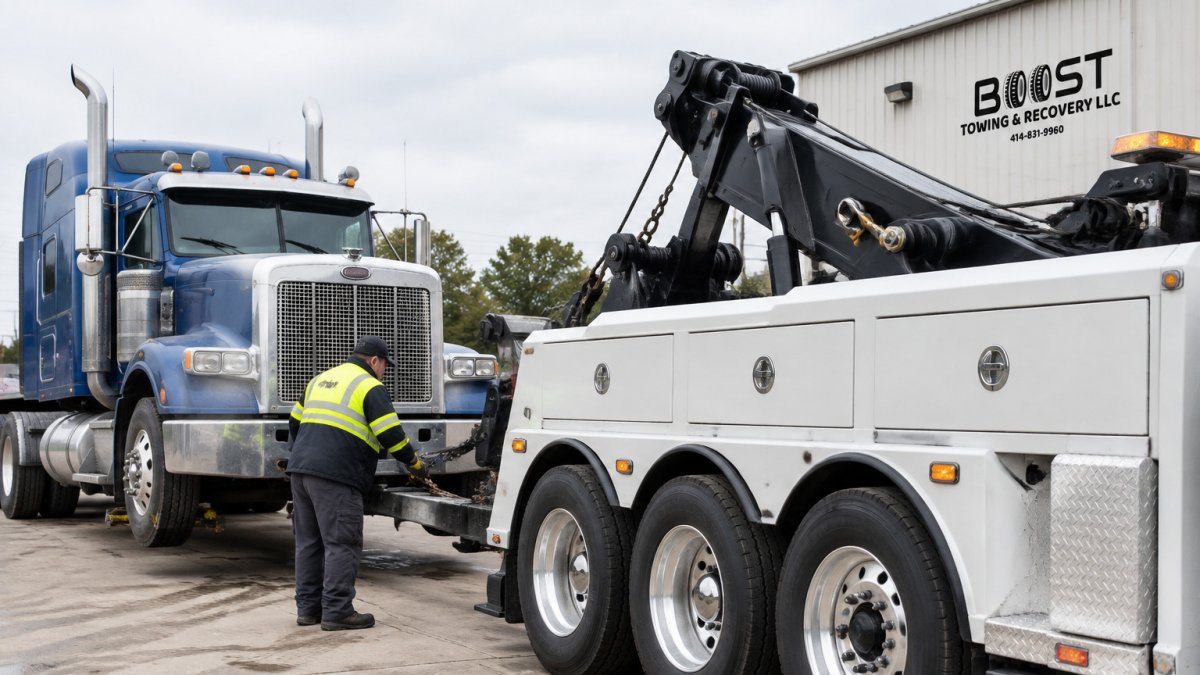
For drivers who want immediate, local help without a yearly membership, Boost Towing & Recovery LLC is our top pick. The company runs 24/7 towing and recovery across southeastern Wisconsin and the central Midwest, with a family-oriented, straight-talking approach.

What Boost Handles on the Spot
Boost covers the situations that strand most drivers:
Lockouts and key retrieval
Jump-starts and battery help
Flat tire changes
Gas delivery
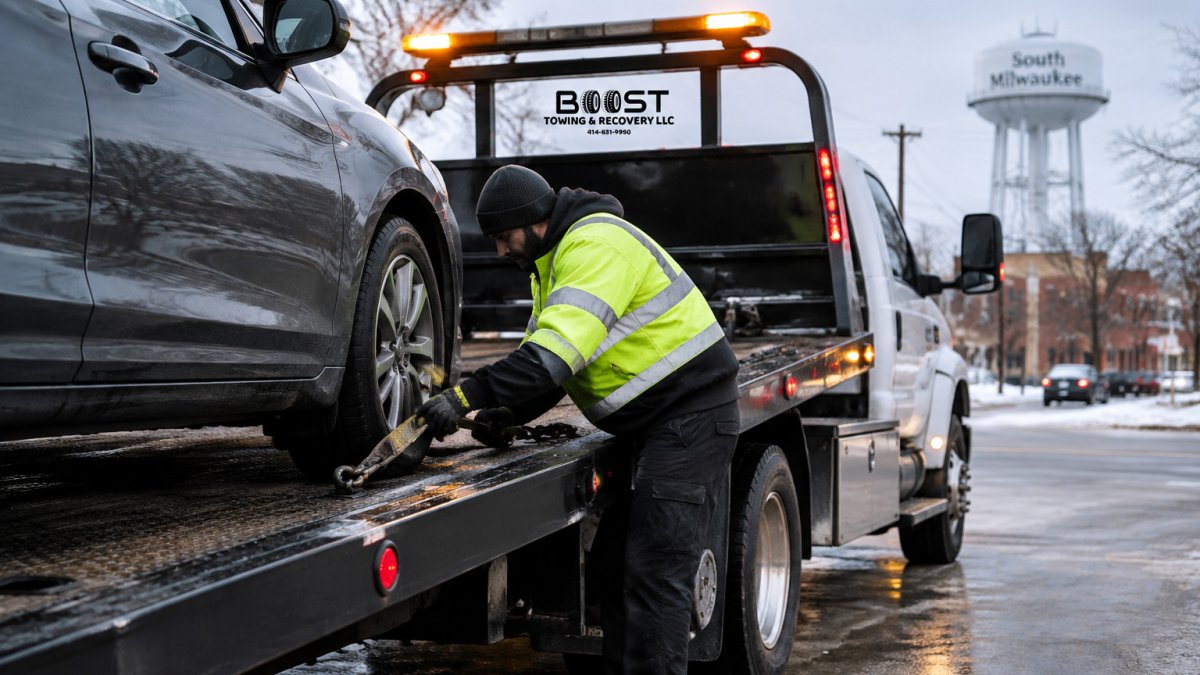
Flatbed and wheel lift transport
Winching and recovery for vehicles off the roadway
The team can move up to two vehicles at once and runs a full-service repair facility, so a breakdown doesn't always mean a second trip to a shop.
Rural vs. Urban Response Times: The Gap Most Guides Ignore
Response time is the number that actually determines how long you stand on the shoulder, and it varies wildly depending on where you are.
In the Milwaukee and Madison metro areas, multiple tow operators compete for the same calls, so a dispatched truck often arrives within 30 to 45 minutes under normal conditions. During a winter storm advisory, that window can stretch past two hours because call volume spikes and road speeds drop.
In rural counties across the northern and central parts of the state, the nearest available truck may be 45 to 90 minutes away even on a clear day. On a holiday weekend or during a storm, waits of several hours are common because a single operator may cover a 50-mile radius.
Key Takeaway The practical rule: buy a national membership for road trips, but save a local operator's number for the drives you make every week. The two aren't competing, they cover different failure scenarios.
Winter-Specific Hazards and Gear to Carry
Cold-weather breakdowns are a different category of problem. A battery that starts fine at 40°F can fail to turn over at 0°F, and a tow that would take 30 minutes in July can take three times as long when the roads are ice-covered and every operator in the county is busy.
Keep these in the vehicle from November through March:
A bag of sand or kitty litter for traction under drive wheels on ice
A compact shovel to dig out a stuck vehicle
Jumper cables or a portable jump-starter, a lithium jump pack works without a second vehicle
An ice scraper and a snow brush with a long handle
Warm gloves, a hat, and a blanket in case you wait in a cold cab
A phone charger and a power bank so a dead phone doesn't become a dead end
Where Boost Fits Best
Boost suits drivers in southeastern Wisconsin who want on-demand service without a yearly membership. Pricing depends on the job, so request a quote upfront to avoid surprises. The tradeoff is clear: Boost's service radius is local, not nationwide. If you drive out of state regularly, pair a local operator's number with a national membership so you're covered in both scenarios.
Wisconsin Department of Transportation winter driving safety tips
AAA: Nationwide Coverage With a Higher Membership Cost
AAA is the household name in roadside assistance, and its network is the reason. Membership starts at $66/year and includes 24/7 emergency dispatch, towing to a nearby facility, battery jump-starts, and tire changes.
Good Sam Roadside Assistance: Built for RVs and Trailers
Good Sam targets a specific driver: the RV owner. Plans start at $64.95/year and include unlimited-distance towing to the nearest service center, fuel delivery, and lockout help.
Geico Roadside Assistance: An Add-On for Existing Policyholders
Geico offers roadside assistance as an add-on to its auto policies. It covers towing, labor, jump-starts, flat tires, and lockouts, and you manage everything through the mobile app.
Erie Insurance Roadside Assistance: Low-Cost Coverage for Policyholders
Erie's add-on is one of the cheapest ways to get covered, starting around $5 per vehicle. It includes towing, on-site mechanical labor, jump-starts, and tire changes, and it earns strong customer satisfaction marks.
Better World Club: Eco-Friendly Coverage for Cars and Bikes
Better World Club is the pick for cyclists and environmentally minded drivers. Plans start at $69.95/year and include 24/7 assistance plus bicycle roadside coverage, a feature almost no competitor offers.
Frequently Asked Questions
Who has the best roadside assistance program in Wisconsin?
The best program depends on your vehicle and driving habits. AAA offers nationwide coverage with a large service network, while Boost Towing & Recovery LLC provides fast local dispatch in southeastern Wisconsin with flatbed and wheel lift trucks. For RV owners, Good Sam is a strong fit. Compare coverage limits, response times, and pricing before choosing.
What is better than AAA for roadside assistance?
For drivers in southeastern Wisconsin, a local provider like Boost Towing & Recovery LLC can be better than AAA because dispatch times are shorter. Boost handles jumpstarts, lockouts, flat tires, fuel delivery, and towing 24/7. Insurance add-ons from Erie may also cost less if you already hold a policy with them.
How much does roadside assistance cost in Wisconsin?
Costs vary by provider and coverage level. AAA start around $66 per year, Good Sam at $64.95, and Better World Club at $69.95. Insurance add-ons can be as low as $5 to $13 per year through Erie. Boost Towing & Recovery LLC prices per service, so contact them for a quote based on your location and vehicle.
Is it better to have a standalone roadside assistance plan or add it to my insurance?
A standalone plan like AAA or Good Sam works regardless of your insurer and often includes extra perks. An insurance add-on is cheaper but ties coverage to your policy and may have lower limits. If you drive an older vehicle or travel through rural areas, a standalone plan or a local provider like Boost gives you more flexibility.
How do I find 24 hour roadside assistance near me in Wisconsin?
Search for providers with 24/7 dispatch and a service radius that covers your location. Boost Towing & Recovery LLC operates around the clock in southeastern Wisconsin and the central Midwest, handling lockouts, jumpstarts, tire changes, and towing. Save their number before you need it, especially if you travel rural highways where response times can be longer.
When a breakdown hits, the plan on paper matters less than who actually shows up. Boost Towing & Recovery LLC delivers 24/7 towing, lockout and jumpstart help, gas delivery, and flatbed transport across southeastern Wisconsin and the central Midwest. Get a quote upfront, skip the membership fees, and get back on the road with a team that treats you like family. Book online with Boost Towing & Recovery LLC today.
Book Online

Comments